
In short
- Most couples argue about the same few issues for years. The goal isn't to end that argument forever. It's to stop it doing the same damage every time.
- Repeat fights run on a loop: a fact, the story you tell yourself, your reaction, her reaction. The topic changes; the loop stays.
- You can change your part: catch the story, say what you heard, answer “this time” instead of “always,” and come back after a break.
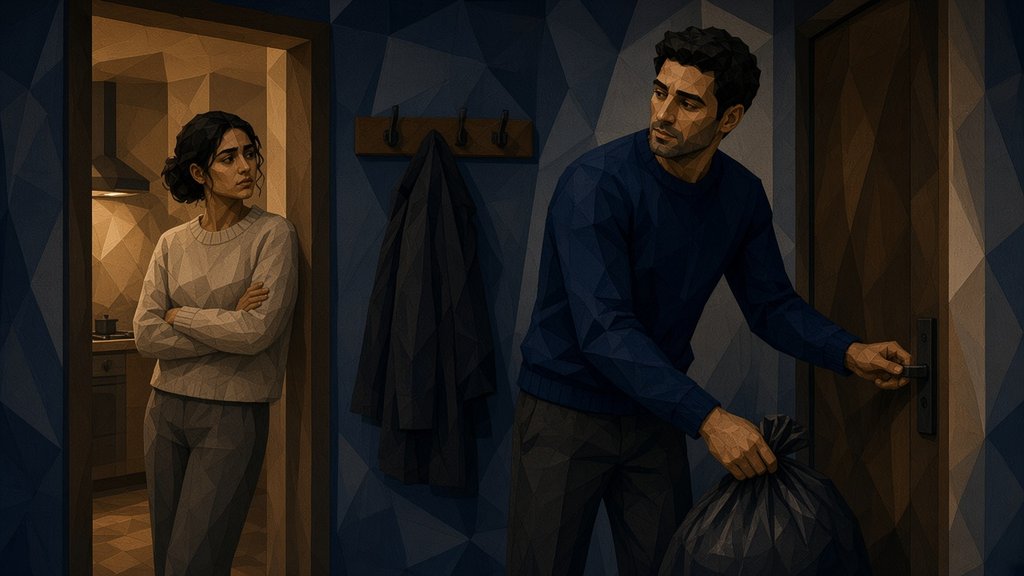
Let's look at an ordinary household situation, the kind couples often argue about. The trash is still by the door. You were about to take it out, but your wife says, “You always say that, and nothing happens.” A few minutes later you're both arguing, standing somewhere you've been a hundred times before. Same lines, same tone, same cold silence after.
Does it sound familiar, even if the reason is different each time?
If you keep having the same fight over and over, here's the short answer: you're probably not fighting about the trash, or whatever the topic is this time. You're stuck in a loop. And a loop is something you can learn to see, and change from your side.
In this article, we'll talk about the patterns that repeat from one argument to the next: the moves you both keep making, over and over again.
The same fight over and over is normal
Psychologist John Gottman brought couples back to his lab four years after recording them discuss their biggest disagreement. 69% of the time, they were arguing about the same issue, and often in much the same way.
He called these perpetual problems. They come from lasting differences in personality and needs, not from a broken marriage. Couples therapist Dan Wile put it bluntly:
“When choosing a long-term partner… you will inevitably be choosing a particular set of unsolvable problems.” — Daniel Wile, After the Honeymoon
So the goal isn't to end the argument forever. It's to stop it from doing the same damage every time.
How the loop works
Most repeat fights run on four steps:
- Something happens. A fact: the trash is by the door.
- You tell yourself a story. “She thinks I'm useless.”
- You react to the story, not the fact. You defend, explain or go quiet.
- She reacts to your reaction. Now you're both fighting about the fight.
The topic rotates: chores, money, her mother, your phone. The loop stays the same.
Step two is where you have the most room. It happens in your head, before a single word.
- Instead of“Here we go again. Nothing I do is ever enough.”
- Try“What do I actually know? She said the trash is still there. That's it.”
Sometimes the fight also pulls in something old: a birthday three years ago, a promise from last spring. That's a related but different thing, covered in My Wife Brings Up the Past in Every Argument.
Name the loop, not the problem
Most of us try to win the argument. Very few try to name it.
- Instead of“I said I'd do it. Why are you making this a thing?”
- Try“I think we're doing this fight again. I don't think it's really about the trash. Can we figure out what it is about?”
It's not a magic line, though. Your wife might not want to talk right after you say it, and that's her choice, which no one can change. We're not here to teach you how to make your wife do something. But you can start with your own move, even though breaking the loop takes two people.
When you accept your side of the loop and can name it clearly, at least to yourself, the loop that has been stuck in one place can finally start moving.
One warning: don't guess what the fight “really” means to her. You don't know until she tells you. Ask, then listen.
What to say and how to behave
You can't plan the fight away. You can plan your part of it. Here's what that looks like before, during and after the next round.
Before the next fight: map your loop
Take the last three arguments you remember. For each one, write down four things: what actually happened, the story you told yourself, what you did, and what she did next.
It takes ten minutes, but you'll likely see the same steps repeat. Once you've seen your loop on paper, it's easier to spot where it begins, and much harder to miss it live.
In the moment: three moves
- Say what you heard before you answer. “So you feel like you're the one who always has to remind me. Is that it?” You're not agreeing or admitting anything. You're showing her you listened, which is often what the fight is really about.
- Answer “this time,” not “always.” If she says “you always,” don't argue with the word. Answer the specific moment: “You're right, I said I'd do it tonight and I didn't. Doing it now.”
- Call a time-out with a return time. If your heart is pounding and your voice is rising, nothing useful will be said. Then come back. A pause without a return time feels like walking out.
- A time-out“I'm getting too heated to listen well. Give me 20 minutes and I'll come back to this.”
The Gottman Institute suggests at least 20 minutes, which is about how long the body needs to settle, and no more than 24 hours before you come back. What to do with your body during that time is in How to Stay Calm When Your Wife Is Angry.
Close the loop
Within a day, go back to it while you're both calm and try to close the loop.
Keep it short: name your part, then ask one question and don't interrupt the answer.
- The next day“Yesterday went badly. My part was getting defensive the moment you said ‘always.’ What does this one actually mean to you?”
Naming your part isn't the same as blaming yourself. The difference is in Guilt and Responsibility in a Relationship.
Once the storm has passed, it's easier for her to talk and for you to listen. Small moves, repeated. That's how the loop loosens: not in one big talk, but the tenth time you catch it a little earlier.
How Husbo helps you see the loop
It's hard to spot a loop while you're inside it, and that's what Husbo is for. It helps you separate what happened from what you assumed, and over time it shows you your own repeating patterns, so you catch them earlier.
Husbo won't help you win fights. It helps you start changing the pattern from your side; ending the loop takes both of you. It takes time, practice and the will to learn. You can try it and see whether it fits you.
FAQ
Is it normal to have the same fight over and over?
Yes. Most recurring fights come from lasting differences between two people, not from a bad relationship. What matters is whether you can come back to each other afterward.
Why do we keep fighting about small things?
The small thing often stands in for something bigger: feeling unheard, unappreciated or alone with a problem. Don't guess which one it is for her. Ask her when you're both calm. One husband's story about a glass left by the sink, and what it meant to his wife, is in How to Make Your Wife Happy.
Can I break the loop if my wife doesn't want to talk about it?
You can change your part: the story you tell yourself, how you respond and how quickly you come back after a fight. Whether she joins in is her choice. Sometimes a change on one side is enough to shift the pattern, though no one can promise that.
Won't taking a time-out look like I'm walking away?
It can, if you just leave. That's why the return time matters. Say how long you need, and come back when you said you would.
How long does it take to stop having the same fight?
Not one conversation. Expect weeks of catching the loop a little earlier each time. Progress looks like shorter fights and faster repair, not zero fights.
When should we get outside help?
If the fights are getting more frequent or more hurtful, or one of you is starting to give up, see a couples therapist. That isn't a failure. It's using the right tool.
This is general guidance, not therapy and not knowledge about your relationship. Every situation is different — it's better to talk yours through with Husbo.
Sources
- 1 Gottman, J. M., & Levenson, R. W. (1999). How Stable Is Marital Interaction Over Time? Family Process, 38(2), 159–165. Four years later, couples discussed the same issue 69% of the time.
- 2 The Gottman Institute. When the Fight Never Ends. Perpetual problems come from lasting differences in personality and needs.
- 3 Dan Wile. Dan's Quotes. “When choosing a long-term partner…” from After the Honeymoon (1988).
- 4 The Gottman Institute. Manage Conflict, Part 4. A break of at least 20 minutes and no more than 24 hours.
- 5 The Gottman Institute. Manage Conflict: The Aftermath of a Fight. Coming back to a fight when calm and naming your part.